
 Published by Sue Johns-Chapman
Published Date 14.07.2026
Published by Sue Johns-Chapman
Published Date 14.07.2026 
Author Viktor Bartak
Hi everyone, my name is Viktor Bartak, here is my LinkedIn, I’ve been doing SEO since 2007, I love talking about it, and today I want to share what I’m seeing in the SEO & GEO & AEO industry in 2026 – the bigger picture and the statistics I’ve gathered.
Let’s start right away with the elephant in the room – everyone now wants to be present in the answers from ChatGPT and other LLMs. How do you do that? It’s very easy and very hard at the same time. Let’s take a look at how it works.
If you ask ChatGPT a simple general-knowledge question, it will give you a simple answer right away. Here’s an example:
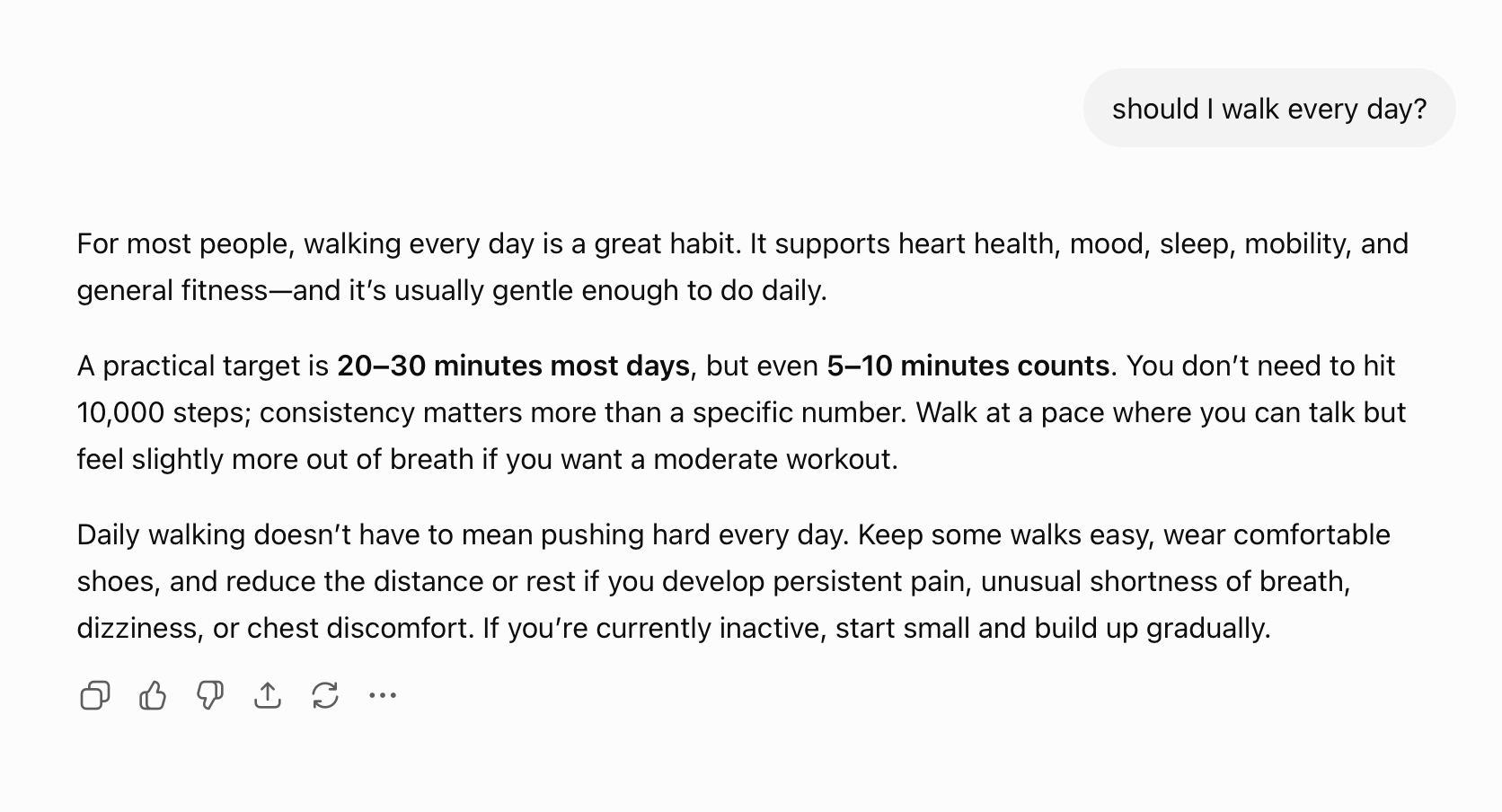
You’ll never make it into general-knowledge answers – there’s no chance of changing an LLM’s answer to the question “should I walk every day?” into something like “yes, btw here are the best walking sneakers and here is a step counter bracelet”.
But we don’t need that anyway, since this general-knowledge area consists mostly of queries with zero commercial value.
Things get far more interesting with commercial queries. When we ask an LLM any question about choosing a company or a product, the LLM can’t answer from its own knowledge – they have neither the resources nor the rationale to index the entire world’s internet.
This is important – training a model on texts from the internet means obtaining weights for the model itself, whereas indexing is a completely different process in which full copies of pages are stored in a database. Indexing requires building a giant infrastructure costing many billions of dollars, and there’s no point to it, because that index already exists in the search engines.
Here’s an example:

The LLM visits pages on the web, extracts a summary from them, and gives an answer simply by processing the results it obtained.
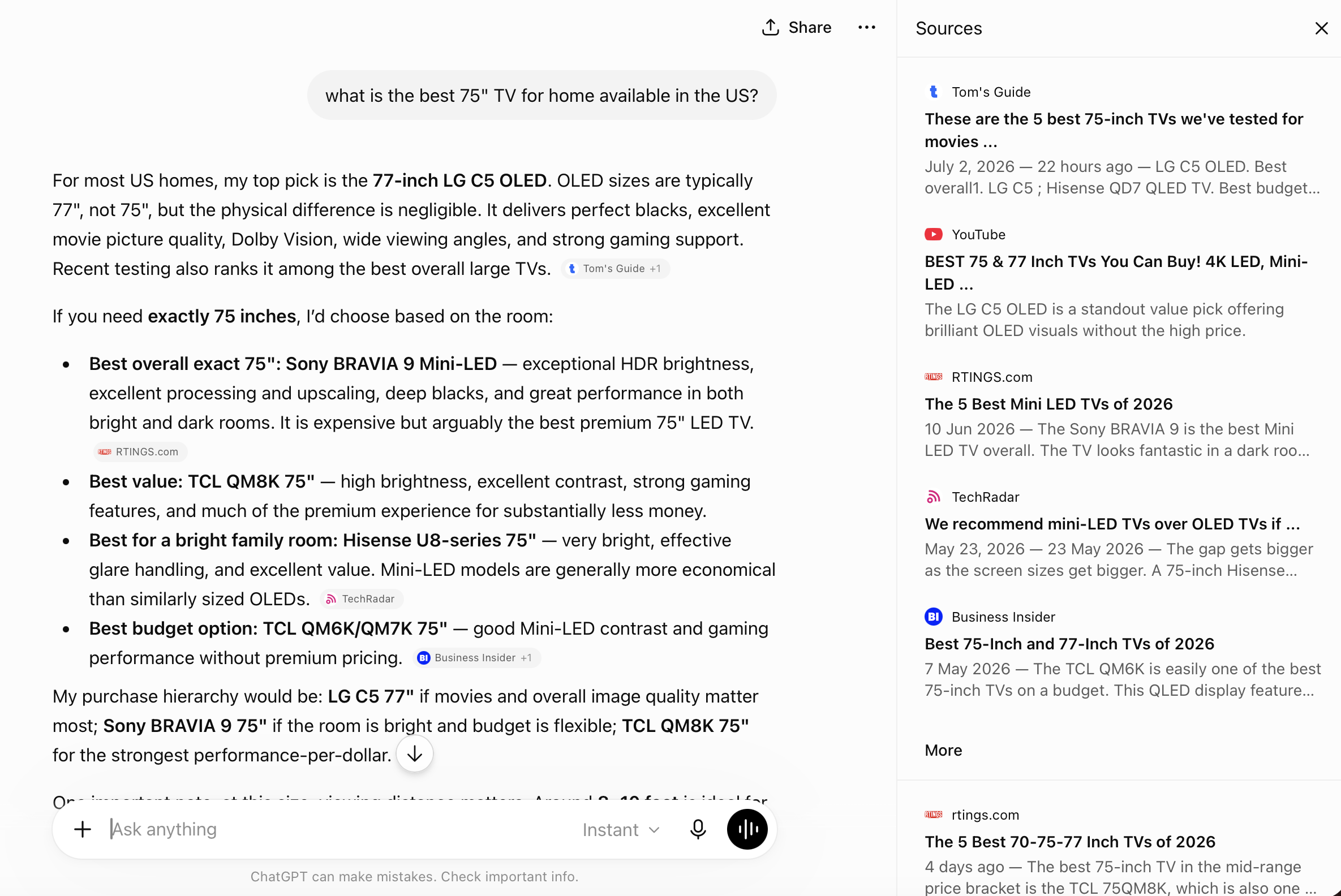
How does the LLM find these pages? The LLM just googles. Or it uses whatever other search engine is convenient for it.
How do you get into an LLM’s answer? Simply be present in the search results. Preferably in several of them.
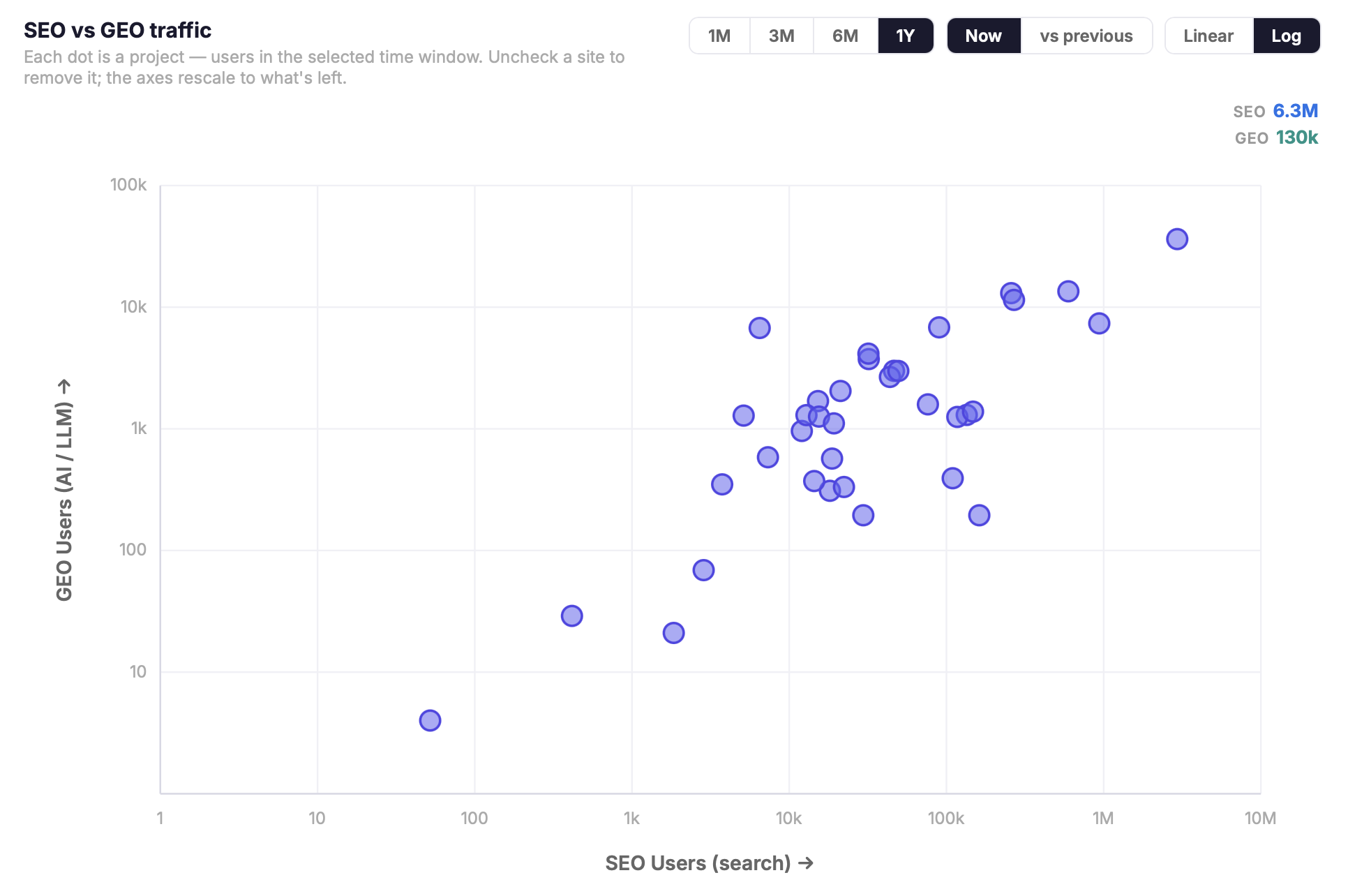
This, by the way, can be verified in another interesting way. I took a sample of about a hundred websites and simply plotted their traffic from search engines, obtained via the Google Analytics 4 API, against their traffic from all LLMs and AI agents on a logarithmic chart, where the X axis is SEO traffic and the Y axis is GEO traffic:
Data for the last year:
Data for the last 3 months:
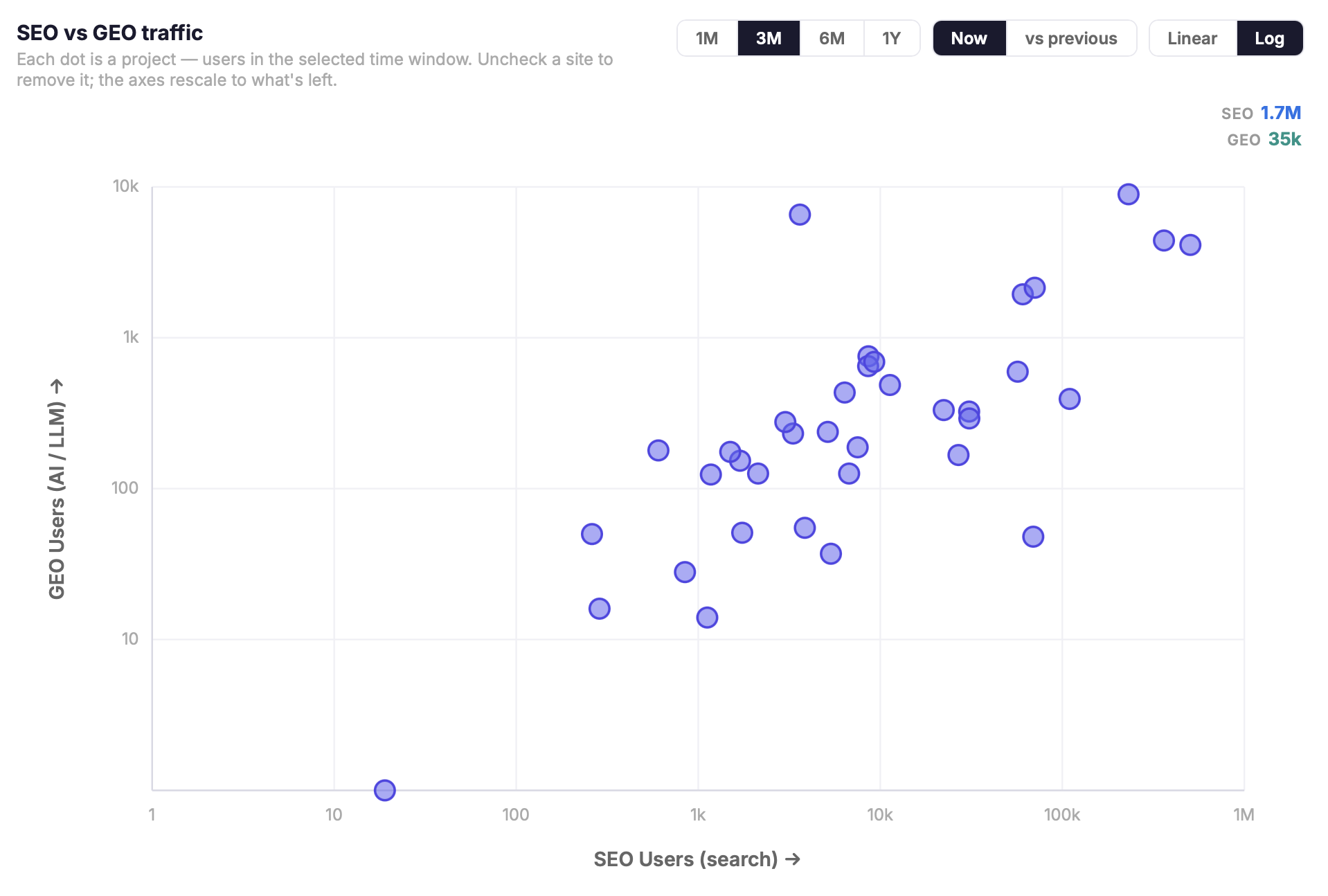
Do you see it too? Clearly, almost all the results lie practically on a single straight line, which tells us there’s an obvious correlation. What’s more, this data can be assessed over time. Let’s compare the last 3 months with the previous ones.
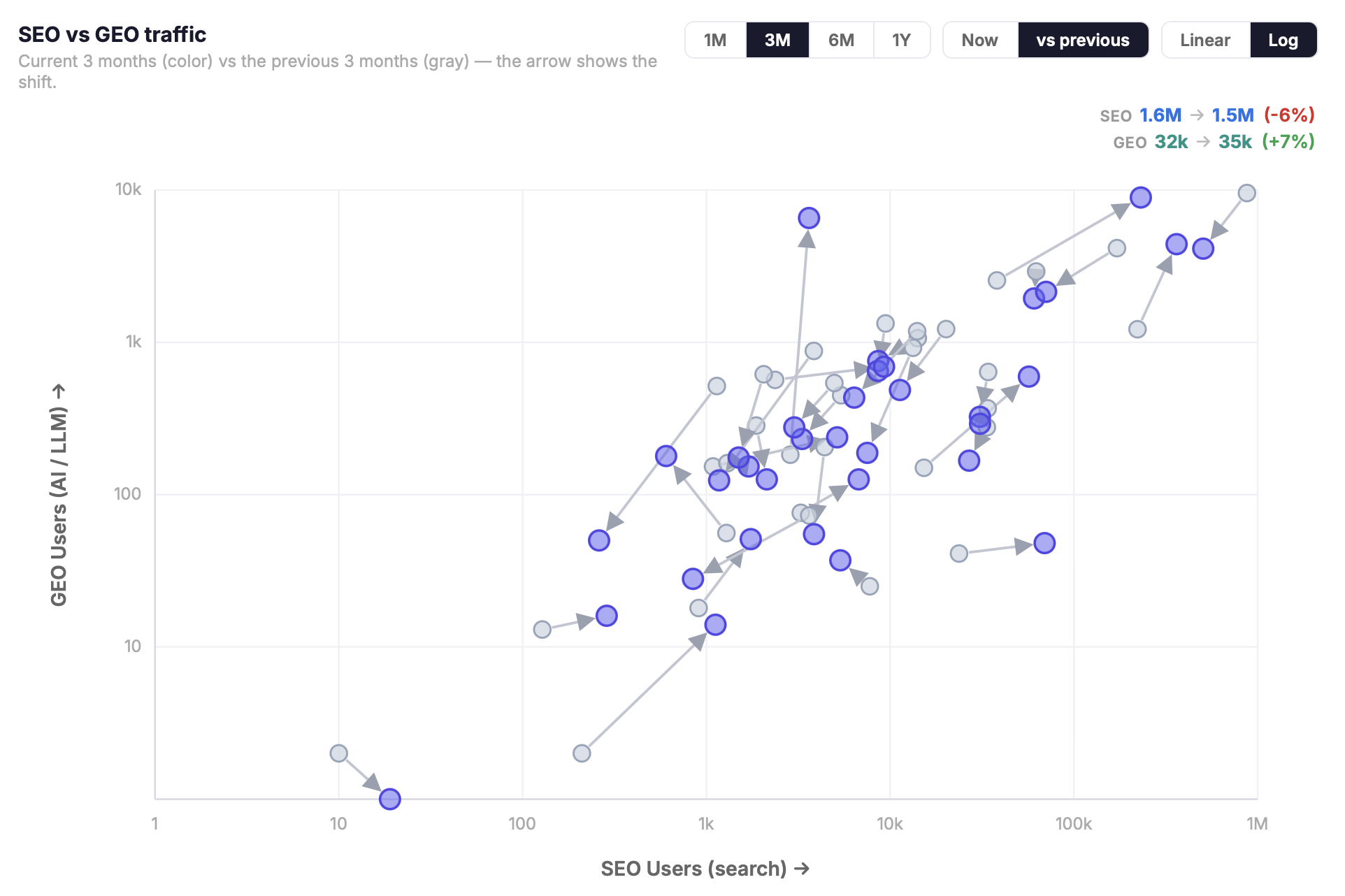
The purple circle is the traffic from the last 3 months from SEO and GEO. The gray circle is the traffic from the previous 3 months. The arrow between them is the direction of the shift. Almost all the arrows run along this line, from the bottom left to the top right. This shows that, for the most part, growth in GEO is proportional to growth in SEO, and conversely, a drop in SEO leads to a drop in GEO.
What do we call the work done to be present in search engine results? Search Engine Optimization. Back to the roots.
This, by the way, is already becoming common knowledge in the industry, which is why demand for SEO services has grown 5x (my god, five times!) in just the last year.
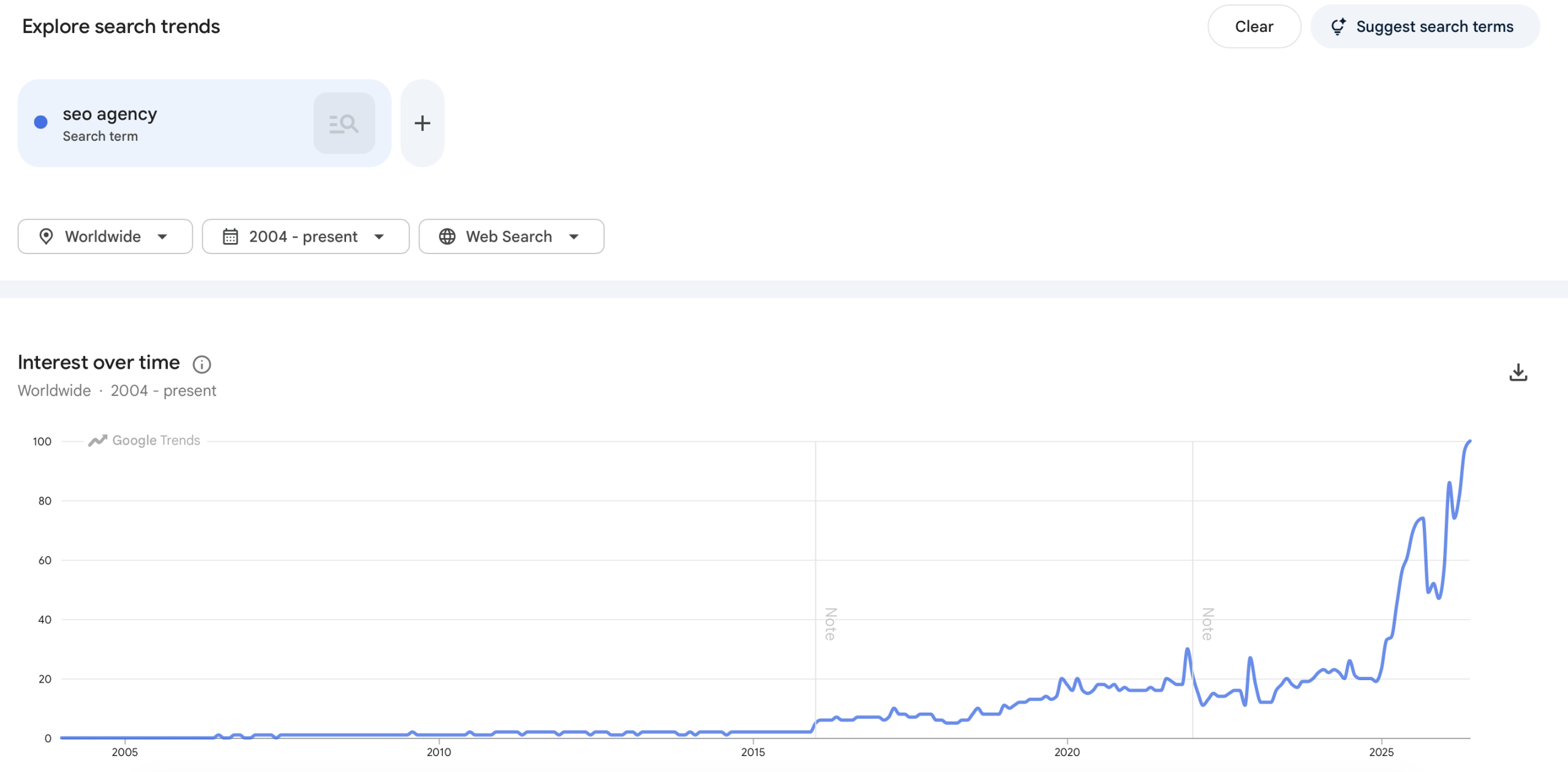
That’s not the only reason for the growth in demand for SEO services, though. The second reason is the catastrophic drop in the cost of developing a new product after Claude Code appeared. A huge number of products have hit the market, and their creators have run into the fact that building a product is only the first step – you still have to push it to market amid an endless glut of products and apps.
That’s why we see almost the same growth in demand for marketing agency and ppc agency too. Although here search demand grew 3x, not 5x:
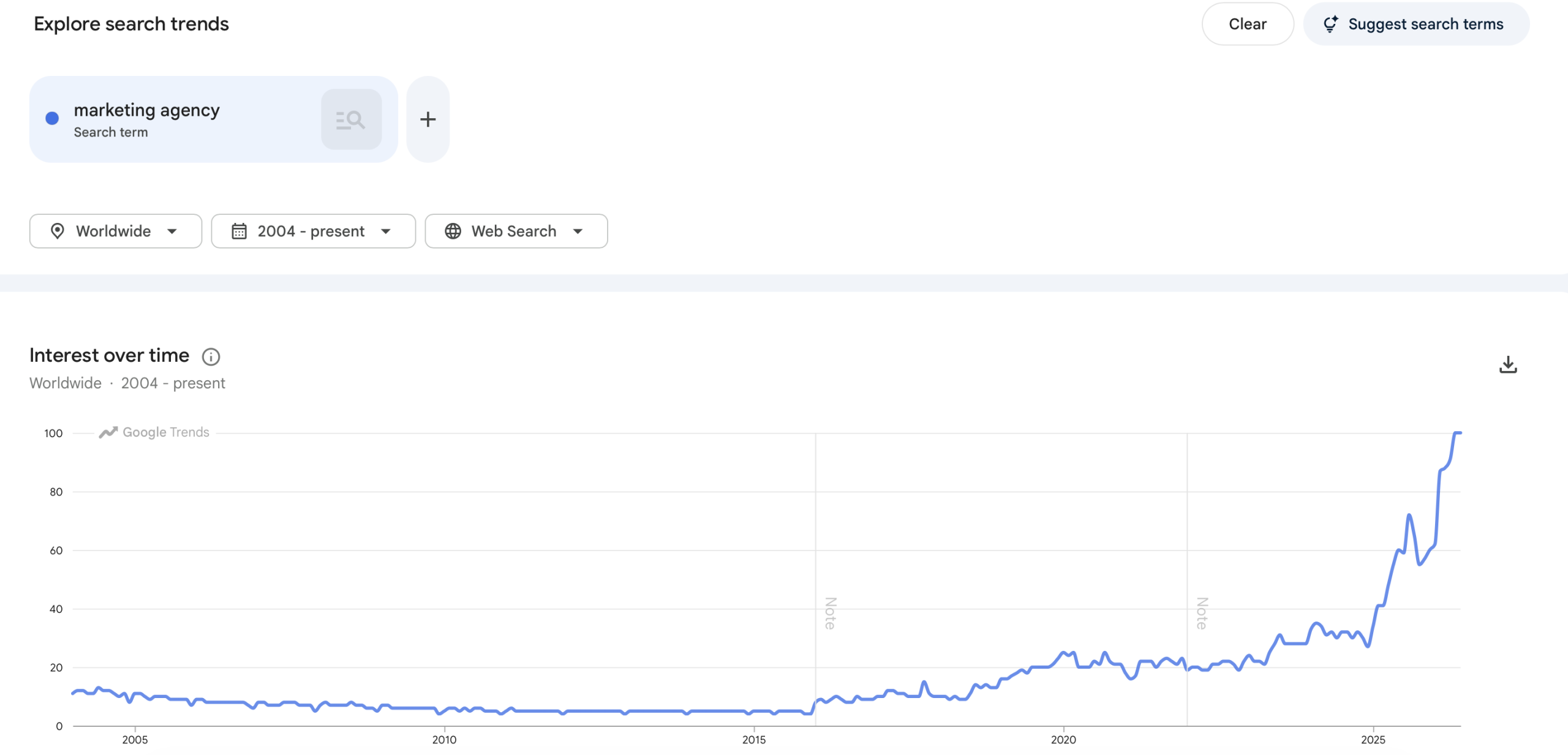
Probably because the rest of marketing doesn’t really help you get into LLM answers – hence this growth.
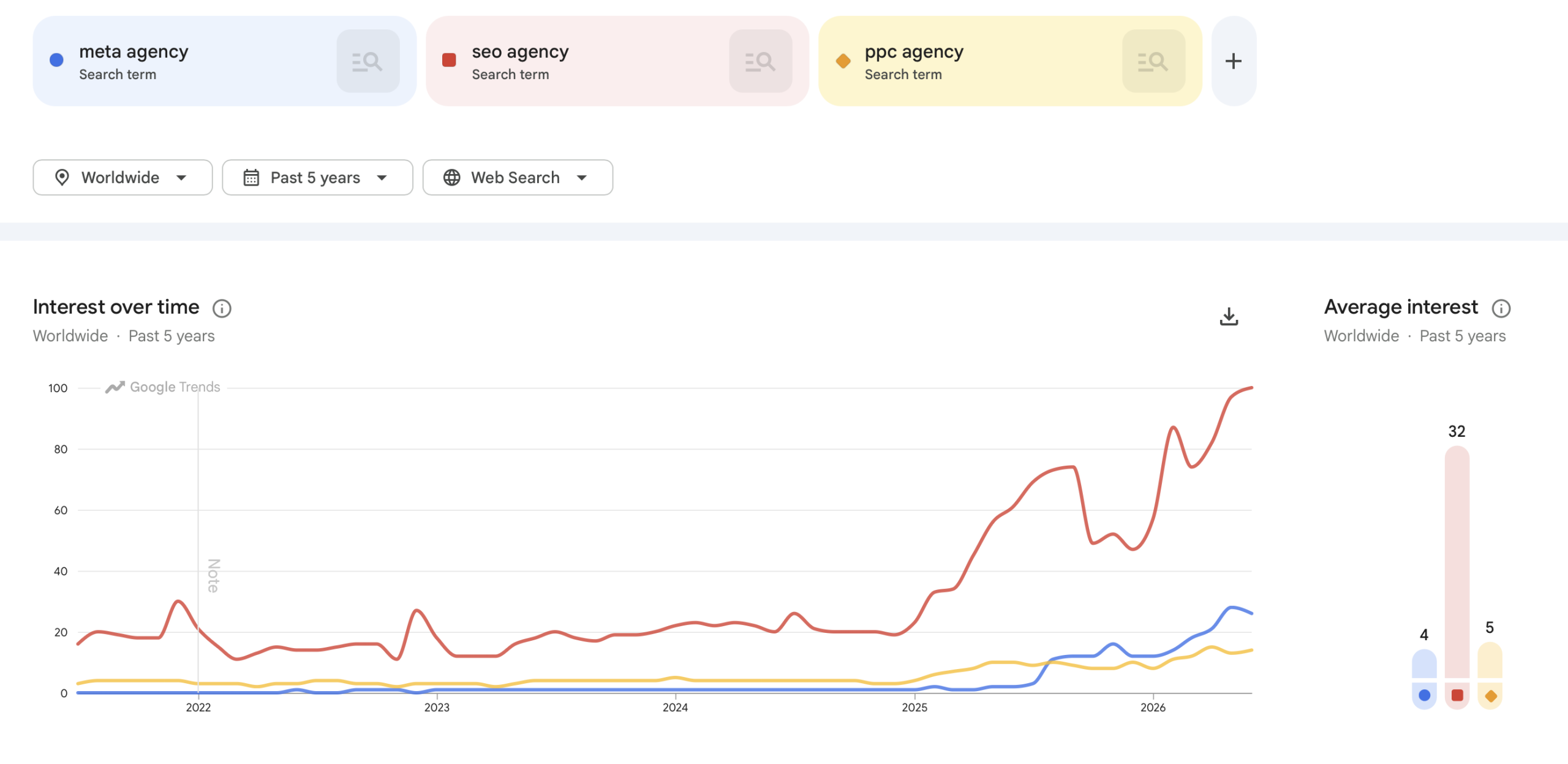
So does this mean we all now need to get into SEO, since demand for the service has grown so much?
Ah, there are some hidden pitfalls here. There are still 10 results on Google’s first page, those results now get half as much traffic because of AI Overviews, and the number of people wanting to land there has grown 5x in just the last year.
What’s more, AI makes it possible to optimize many SEO processes, but at the same time, mass-generating content and publishing it on a site without enough authority is a virtually guaranteed way to send the site into a deep ban, from which there’s simply no way back.
That’s why I’d say that in 2026 the competition for the first position has grown roughly 10x compared to 2025.
Which I can’t help but be glad about – I literally enjoy this game, with its constant new challenges and a game world that changes every day. It never gets old 🙂